Germany has removed the double grid fee that made vehicle-to-home (V2H) and vehicle-to-grid (V2G) uneconomic — but most drivers still cannot use it, because too few cars, chargers and approvals are ready. The economics changed on October 1, 2026, but hardware and paperwork have not caught up yet. If you need backup power now, a separate inverter system remains the practical route, while V2H matures.
On October 1, 2026, Germany’s Federal Network Agency (BNetzA) adopted MiSpeL decision 618-25-02 on integrating storage and charging points into the market. With an Energy Industry Act (EnWG) amendment passed by the Bundestag on November 13, 2025, which treats a bidirectional charging point as storage, it removes the old double charge: electricity charged into a car and then sent back could attract grid fees and levies twice. As reported by innobu on October 17, 2026, that double charge had made V2G hard to justify and left Germany among Europe’s most restrictive markets for bidirectional charging.
MiSpeL offers two paths: a flat-rate option for household solar up to 30kWp with one bidirectional meter, capped at 500kWh per kWp per year and, as of early October 2026, still awaiting EU state-aid approval; and a precisely metered option, based on 15-minute metering and usually two meters, open to everyone. This article summarises published regulatory facts, not legal advice for any individual installation.
Why the Math Matters NowThe saving is real but modest. Market participants estimate savings of about 110 to 190 euros per year in avoided grid fees, depending on the grid region. That is an estimate, not a guaranteed payment. Extra value from solar self-consumption, load shifting and V2G tariffs also depends on the tariff a household can actually buy.
The deeper reason is scale. As innobu put it, a typical car battery holds several times the capacity of a usual home storage unit, and a car spends most of the day parked and plugged in. On paper, the car could cover evening loads without a second large battery — but removing the double fee does not, by itself, make every car a home battery.
The Hardware Bottleneck: Cars Lag BehindBidirectional charging only works when car, charger, meter and grid all use ISO 15118-20 for AC bidirectional charging, finalised in 2022 and now reaching production; the March 2026 edition of VDE-AR-N 4105 also unified German low-voltage connection requirements. Even so, the cars named in October reporting remain few: the BMW iX3, larger-battery VW ID models, the Renault 5, the Kia EV9, and the Nissan Leaf on the older CHAdeMO standard. Most cars on the road, and most models on sale, are not on that list.
Chargers are only just arriving too. AC bidirectional chargers supporting ISO 15118-20 at up to 22kW reached the market through 2025 and 2026, so choice is still narrow, and Germany’s first commercial V2G tariff, launched in February 2026, covers only a narrow car-and-charger combination. This angle differs from earlier pieces here: Chery was a Chinese demonstration site, Tesla in the United States required a Powerwall first, and Audi’s A2 e-tron was limited to three countries. Germany’s story is about economics, not a single car launch.
The second bottleneck is administrative. Until September 30, 2027, both MiSpeL paths still require the agreement of the local grid operator and the metering operator for each installation. After that date, operators are obliged to support the arrangements. Until then, each case needs consent, so early adopters should budget time and paperwork, not just equipment cost.
So the honest sequence today is: check your car, check a compatible 22kW AC charger for your connection, check operator agreement during the transition period, and only then compare tariffs. If any link fails, V2H is not yet available to you.
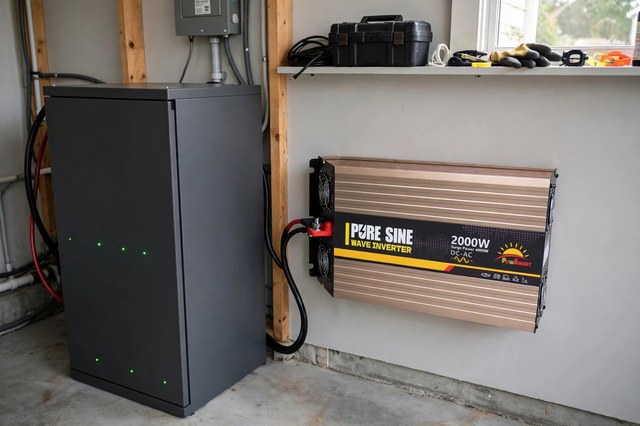
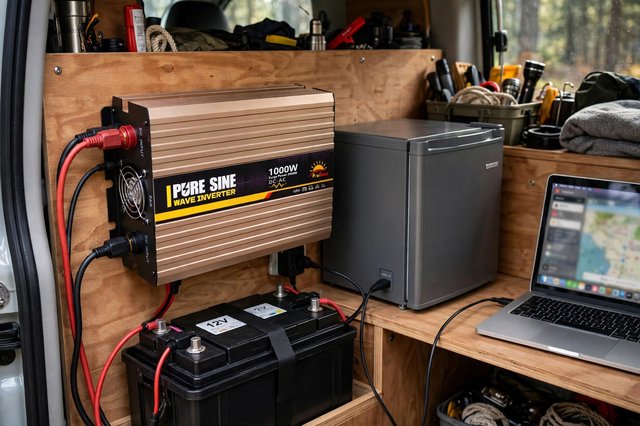
The Separate-System Alternative That Works TodayA standalone pure sine wave inverter does not wait for that chain. Sunrise New Energy (Powsmart) builds inverters from 300W to 6000W, in 12V, 24V and 48V versions, chosen by load rather than car model. List the loads you cannot lose, pick an inverter with headroom for starting surges, and pair it with a battery sized for the hours you need — no carmaker rollout or tariff consent stands in the way, because the system is separate from the car.
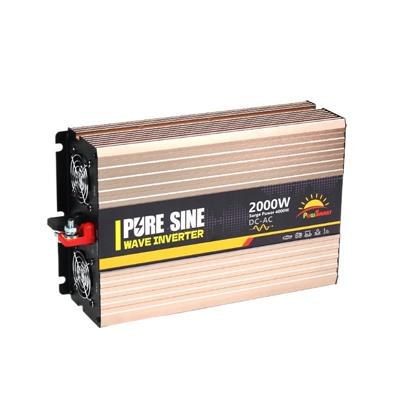
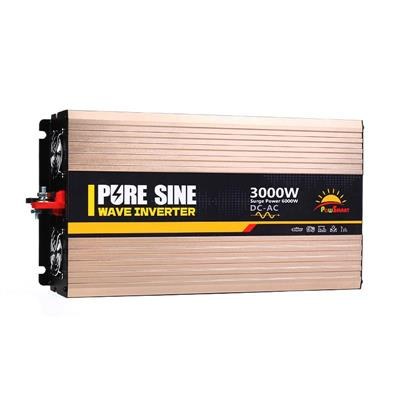
See the 2000W pure sine wave inverter (4000W peak) and the 3000W pure sine wave inverter (6000W peak), or the full REP pure sine wave inverter series. It is available on any car, house and battery you choose today.
How to Size Yours: A Worked ExampleStart with critical loads, not a headline wattage. A typical list: a fridge at about 150W running, LED lights at about 60W, a router at about 15W and phone charging at about 20W, for about 245W running. A fridge compressor needs a short starting surge several times its running power, so a 2000W inverter with a 4000W peak gives comfortable headroom; a 3000W model, with a 6000W peak, adds room for a microwave or washing machine used one at a time. Size the battery from runtime: at roughly 500W, a 2kWh usable bank lasts about four hours in theory, before losses and reserve, so always round up.
Three things will show whether V2H becomes ordinary: more cars beyond the handful named above, chargers and tariffs as a standard retail offer rather than a narrow pilot, and a clean end to the transition period on September 30, 2027. Until all three arrive, V2H in Germany is a real policy breakthrough with a slow rollout — worth following, not worth waiting for if you need backup power this winter.
Frequently Asked QuestionsNot automatically. You still need a compatible car, charger and metering, and, until September 30, 2027, the agreement of your grid and metering operators.
Market participants estimate about 110 to 190 euros per year in avoided grid fees, depending on the grid region. Treat that as an estimate, not a promise, and compare it with the cost of a compatible car, charger and tariff.
The October 2026 reporting names the BMW iX3, larger-battery VW ID models, the Renault 5, the Kia EV9 and the Nissan Leaf on CHAdeMO. If your car is not on a list like that, assume it cannot do V2H or V2G until its maker confirms otherwise.
Use a separate system: pick a pure sine wave inverter by your critical loads — for example a 2000W model for fridge, lights, router and laptop, or a 3000W model for larger appliances — and pair it with a battery sized for your target runtime.
Germany’s V2H economics are real, but cars, chargers and approvals are still catching up. Contact Sunrise New Energy to size a standalone inverter for your critical loads, and revisit V2H when your car, charger and operator are all ready. Source: innobu, October 17, 2026, on BNetzA MiSpeL decision 618-25-02 (October 1, 2026) and the EnWG amendment (November 13, 2025).

We use cookies to enhance your browsing experience, serve personalized ads or content, and analyze our traffic. By clicking "Accept All", you consent to our use of cookies.