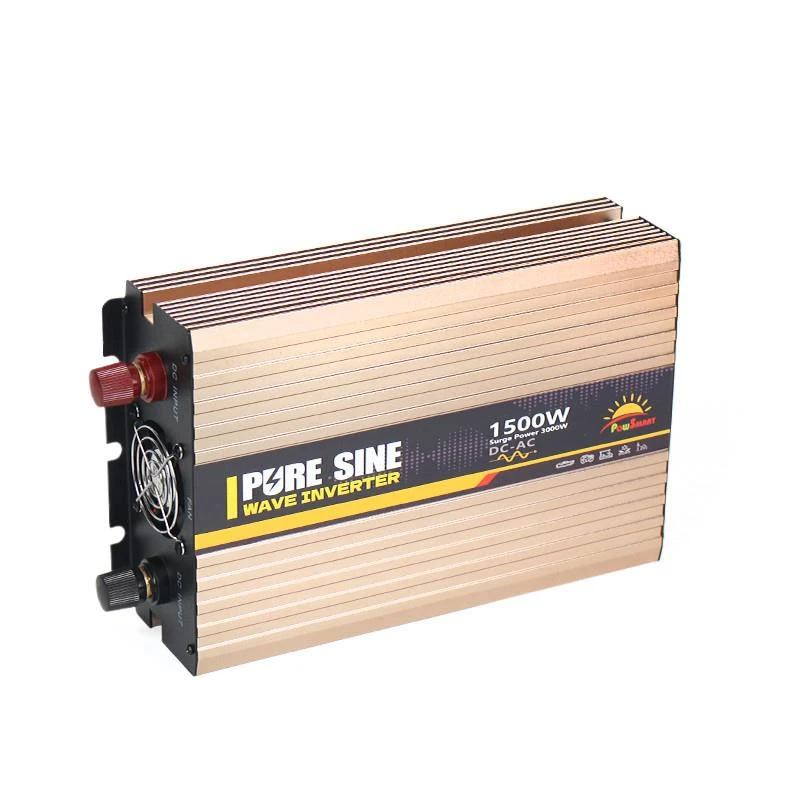
A 1500W pure sine wave inverter is the middle step most buyers skip. Rated 1500W continuous with 3000W of peak power, it runs a fridge with a TV, lights and a laptop, or a single power tool of up to about 1200W. If 1000W cannot start your tool and 2000W feels oversized, 1500W is usually the right answer.
Sunrise New Energy (Powsmart) builds the REP1500 in 12V, 24V and 48V versions, all with a pure sine wave output and total harmonic distortion below 3% under linear load — clean household-mains power for sensitive electronics.
What a 1500W Inverter RunsThe product page gives the load list: a 1500W inverter runs a fridge with a TV, lights and a laptop at the same time, with room left for a phone charger or a small fan.
Power tools draw a starting surge when the motor spins up. The REP1500 handles tools rated up to about 1200W on their own — a drill, a small circular saw or a battery-tool charger, one at a time. Do not stack a running tool on the fridge-and-TV combination; the 3000W peak covers the startup spike.
An electric kettle is the edge case: it only works if rated under 1500W, and then only on its own. Most full-size kettles are 1500–2200W, so check the label first; over 1500W belongs on the 3000W model.
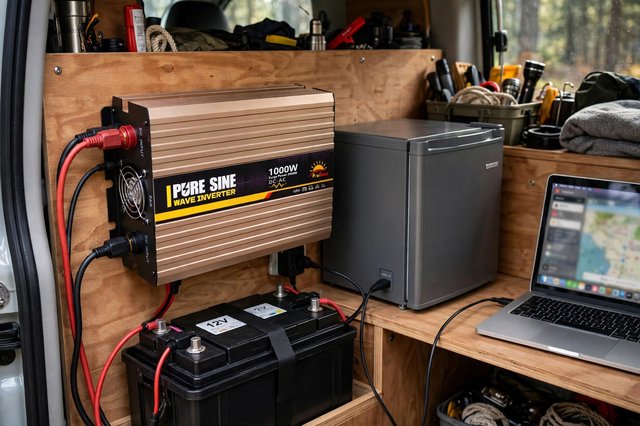
Pick by the list, not by the number on the box.
The 1000W model (2000W peak) runs a fridge at 100–150W with a TV, lights and a laptop, and power tools up to about 800W. A microwave is beyond it. Choose it for a light list: camping lights, laptop, phone charging and a small fridge.
The 1500W model (3000W peak) adds the 1200W tool and the under-1500W kettle, used on its own. Choose it when 1000W would stall on your tool, but your list has no microwave or washing machine.
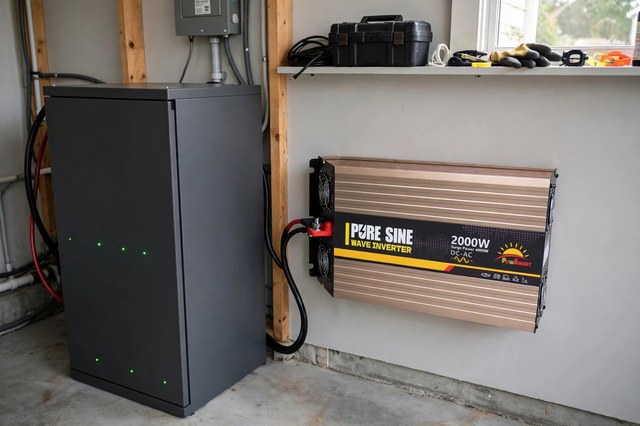
The 2000W model (4000W peak) adds a 1000–1200W microwave and heavier intermittent loads — choose it when the list includes a microwave, or two motor loads may start near the same time.
At 12V, the 1000W model draws about 93A at full load and the 1500W about 139A; the 2000W sits between the 1500W figure and the 3000W figure of about 278A — which is why the 12V version needs short, thick DC cables and a fuse sized to the manual. See the full REP pure sine wave inverter series for all nine sizes from 300W to 5000W.
How to Size an Inverter in Three StepsFirst, list every load you want to run at the same time and write down its running watts from the label. Second, add a starting surge for anything with a motor: fridges, compressors and power tools typically draw two to three times their running watts for a second or two at startup. Third, compare the total against the rated power, not the peak — the 3000W peak is for starting surges; 1500W is what the inverter delivers continuously. If the running total is over 1500W, or one motor's surge pushes past 3000W, step up a size.
12V, 24V or 48V: Which Version?Match the battery system you already have. For a new solar or backup installation, 24V or 48V is usually better: at 1500W a 12V battery must deliver roughly 139A, while a 48V system delivers the same power at about a quarter of that current. Efficiency is 90% on 12V, 92% on 24V and 95% on 48V.
Higher voltage also means thinner DC cables and less voltage drop — useful in an RV or cabin where the battery sits metres from the inverter.
The REP1500 protects the battery with voltage cut-offs that differ by version. On 48V, only the low-voltage protection is ±0.5V; the rest are ±1V.
| Protection | 12V | 24V | 48V |
|---|---|---|---|
| Low-voltage alarm | 10.5 ± 0.5V | 21 ± 0.5V | 42 ± 1V |
| Low-voltage protection | 10 ± 0.5V | 20 ± 0.5V | 40 ± 0.5V |
| Low-voltage recovery | 12.3 ± 0.5V | 24 ± 0.5V | 48 ± 1V |
| Over-voltage protection | 15.5 ± 0.5V | 31 ± 0.5V | 61 ± 1V |
| Over-voltage recovery | 14.8 ± 0.5V | 29.5 ± 0.5V | 59 ± 1V |
Input range is 10–15.5V, 20–31V and 40–61V; working temperature is −10 to 50°C. Wire size, fuse rating and battery capacity follow the manual for your exact model.
One detail differs by version: the 12V and 24V versions have a QC3.0 USB port; the 48V version has none.
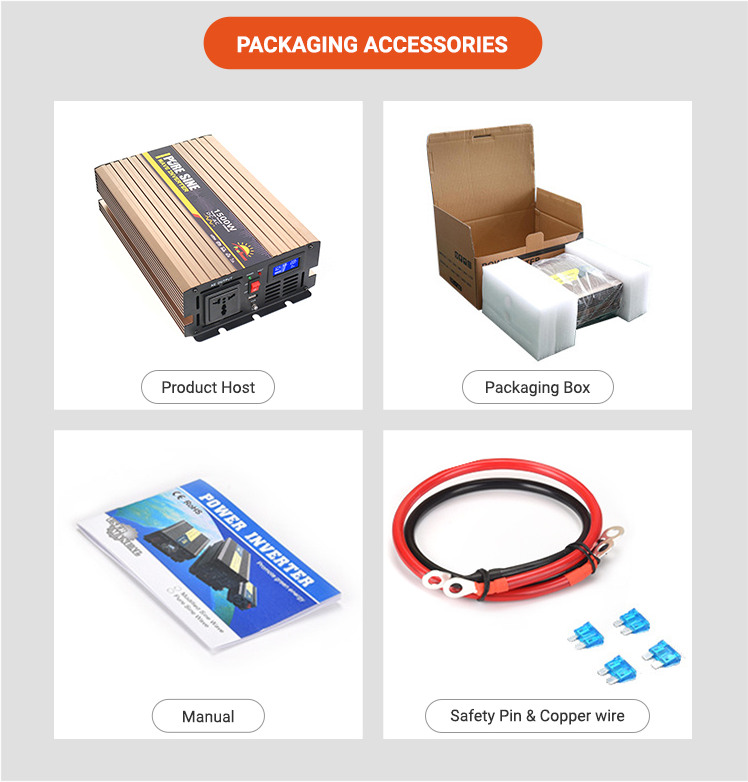
At 2.9kg net (3.4kg gross, six per carton), the REP1500 is light enough to carry between a vehicle and a cabin, and it can be ordered with OEM/ODM shell colour and branding, EU, USA, Japan, UK, Australia or universal sockets, and custom DC input voltages.
What a 1500W Inverter Cannot DoTwo limits are worth stating plainly. This is an inverter only — it converts DC to AC and does not charge the battery; for mains charging, ask about the inverter-with-charger (UPS) models. And it is not a whole-house backup unit: it covers one room of essentials or one job at a time, while a full house needs the 5000W model or larger home storage.
Frequently Asked QuestionsYes — a running fridge draws about 100–150W, a TV 60–150W, lights 10–30W and a laptop 45–90W, so the combination fits well inside 1500W; the 3000W peak covers the fridge's starting surge.
It depends on the microwave. A compact microwave rated well under 1500W can run on its own, but check its starting surge against the 3000W peak. A full-size 1000–1200W microwave is safer on the 3000W model.
Match the battery system you have. For a new solar or backup installation, 24V or 48V is usually better: at 1500W a 12V battery must deliver roughly 139A, while a 48V system delivers the same power at about a quarter of the current.
It warns first, then cuts off. On 48V the alarm sounds at 42 ± 1V, cut-off is at 40 ± 0.5V, and it restarts at 48 ± 1V. The same staged protection applies on 12V and 24V — see the table above.
No charging — this is an inverter only; ask about the UPS models with a built-in charger if you need mains charging. The QC3.0 USB port is on the 12V and 24V versions only; the 48V version has none.
A 1500W pure sine wave inverter fits when your load list is one step past 1000W: a fridge with a TV, lights and a laptop together, a single 1200W tool, or an under-1500W kettle used on its own. Size from the load list, let the 3000W peak cover motor starts, and pick the voltage that matches your battery.
Still choosing between 1000W, 1500W and 2000W? Send Sunrise New Energy (Powsmart) your load list — loads, battery voltage, car, RV, truck or cabin — and we will help you pick the size that fits, before you buy.

We use cookies to enhance your browsing experience, serve personalized ads or content, and analyze our traffic. By clicking "Accept All", you consent to our use of cookies.