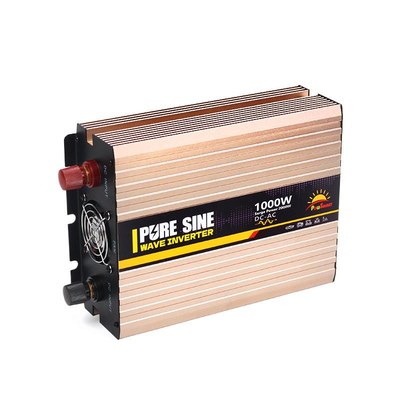
A 1000W pure sine wave inverter runs a fridge, a TV with lights and a laptop, or power tools up to 800W — but a microwave is too much for it. That is the short answer for Sunrise New Energy (Powsmart)’s REP1000: 1000W rated, 2000W peak, pure sine wave with THD below 3% under linear load. If your load list fits inside those two numbers, 1000W is the smallest size that does the job properly; if not, stepping up is cheaper than replacing an overloaded inverter. Every number below comes from the REP1000 product page itself.
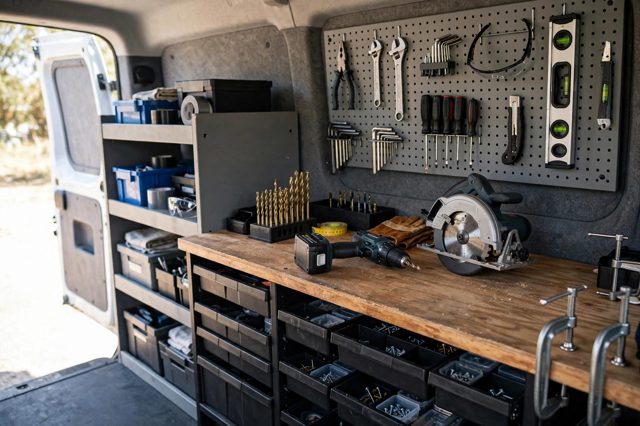
What a 1000W Inverter RunsThe product page gives three load combinations, with the microwave as the dividing line. A fridge runs at 100–150W, and its compressor start-up surge stays inside the 2000W peak, so it keeps food cold in a camper, a truck cab or a small off-grid cabin. The second is a TV with lights and a laptop together — the everyday evening load in a vehicle or a backup setup. The third is a single power tool of up to about 800W, run one tool at a time.
What it cannot do is just as clear: a microwave is too much for this size. Before buying, read the nameplate watts on every appliance you plan to run.
| Load | Running power | Verdict on 1000W |
|---|---|---|
| Fridge | 100–150W, surge inside 2000W peak | Yes |
| TV lights laptop | Combined load, per product page | Yes |
| Power tool, one at a time | Up to about 800W | Yes |
| Microwave | Above this size | No |
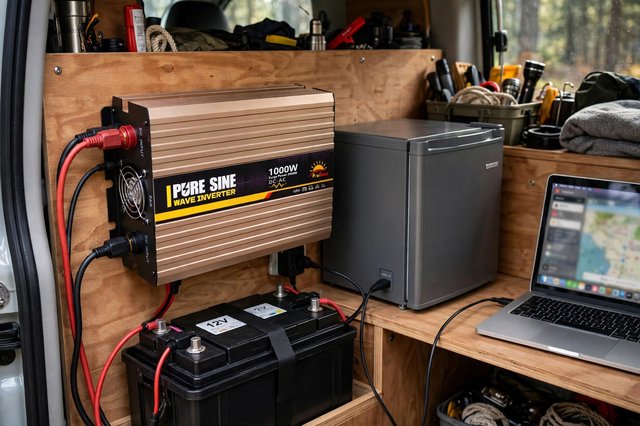
Step 1: list the loads you will run at the same time. Write down each appliance and its running watts from its nameplate. Loads that take turns do not add up; loads that run together do.
Step 2: add the running watts and keep the total under 1000W. Leave headroom instead of running at the limit all day. A fridge plus the TV, lights and laptop combination is two of the product page’s load cases at once, so size for the bigger case.
Step 3: check motor start-up against the 2000W peak. Fridge compressors and power tools draw roughly two to three times their running watts for a second or two at start-up. That surge must fit inside the 2000W peak. If any single load’s start-up surge passes 2000W, the size is wrong even when its running watts look small.
1000W vs 2000W vs 3000W: When to Step UpThe three sizes share the same protection behaviour; only the power changes. The REP1000 is rated 1000W with a 2000W peak. The 2000W model doubles both numbers to 2000W rated and 4000W peak, buying headroom for bigger tool loads and for running the fridge case and the TV case at the same time. The 3000W model, covered in our 3000W sizing guide, is rated 3000W with a 6000W peak and takes a 1000–1200W microwave, a washing machine and a small air conditioner, provided each start-up surge is checked against the 6000W peak.
So the rule is: buy 1000W when your whole simultaneous list fits under 1000W continuous and every start-up surge fits under 2000W peak, and step up the moment either number is passed. Oversizing wastes money and battery; undersizing wastes the inverter.
| Model | Rated / peak | Typical loads |
|---|---|---|
| REP1000 | 1000W / 2000W | Fridge, TV lights laptop, tools to 800W |
| REP2000 | 2000W / 4000W | Bigger tool loads, both cases at once |
| REP3000 | 3000W / 6000W | 1000–1200W microwave, washer, small air conditioner |
The REP1000 comes in 12V, 24V and 48V: choose the voltage your battery system already uses. For a new solar or backup installation, 24V or 48V is usually better, and the product page explains why with one number: at 1000W a 12V battery has to deliver roughly 93A, while a 48V system delivers the same power at about a quarter of that current, with higher efficiency and cooler cables.
Efficiency rises with voltage — 90% on 12V, 91% on 24V, 93% on 48V — while no-load current falls from under 0.4A to under 0.3A to under 0.2A. A 12V system at this power needs short, thick DC cables and careful connections, because 93A punishes every weak joint; 48V is far more forgiving on the same watts. Wire size and fuse ratings always follow the manual for the voltage you choose.
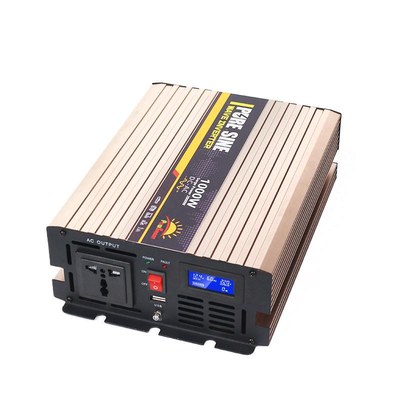
All six models — REP1000-121/241/481 (110V output) and REP1000-122/242/482 (220V) — share the same protection values at the same input voltage. Only the low-voltage protection on the 48V version is ±0.5V; the other 48V tolerances are ±1V. The inverter measures 275 x 180 x 80mm and weighs 2500g net, 2950g gross. If it shuts down, our five-check troubleshooting guide walks through the causes in order.
| Protection | 12V | 24V | 48V |
|---|---|---|---|
| Low-voltage alarm | 10.5±0.5V | 21±0.5V | 42±1V |
| Low-voltage protection | 10±0.5V | 20±0.5V | 40±0.5V |
| Low-voltage recovery | 12.3±0.5V | 24±0.5V | 48±1V |
| Over-voltage protection | 15.5±0.5V | 31±0.5V | 61±1V |
| Over-voltage recovery | 14.8±0.5V | 29.5±0.5V | 59±1V |
| Max. efficiency | 90% | 91% | 93% |
Three installation habits decide whether a 1000W inverter runs quietly for years or trips on its first hot day. First, keep DC cables short and thick, and size wire and fuse exactly as the manual specifies for your input voltage — at roughly 93A on 12V, an undersized cable is a heater, not a conductor. Second, give the cooling fan clear air: keep the vents uncovered and the unit out of direct sun in a closed vehicle. Third, remember what this unit is: a pure inverter only, converting DC to AC. It does not charge the battery from mains power; if you need mains charging in the same unit, ask about the inverter-with-charger (UPS) models instead.
OEM and ODM orders can customise shell colour and branding, with EU, USA, Japan, UK, Australia and universal sockets available and custom DC input voltages on request. See the full REP pure sine wave inverter series for the 300W to 5000W range.
Frequently Asked QuestionsYes. A fridge runs at 100–150W, and its start-up surge stays inside the 2000W peak, so the REP1000 handles it on any input voltage.
No. A microwave is too much for this size. A 1000–1200W microwave needs the 3000W class, rated 3000W with a 6000W peak.
Match the battery system you already have. For a new installation, 24V or 48V is usually better: at 1000W a 12V battery must deliver roughly 93A, while 48V needs about a quarter of that current.
No. This is an inverter only, converting DC to AC. For mains charging in the same unit, ask about the inverter-with-charger (UPS) models.
Tools up to about 800W run one at a time on the REP1000. Check the tool’s nameplate watts and start-up surge against the 2000W peak, and step up to the 2000W model if either number is passed.
Still unsure whether 1000W is enough? Write down your load list with running watts from each nameplate, then contact Sunrise New Energy (Powsmart) to match it to the right REP model.

We use cookies to enhance your browsing experience, serve personalized ads or content, and analyze our traffic. By clicking "Accept All", you consent to our use of cookies.