An inverter PCBA board is the working core of an inverter without the box around it. If you can build the enclosure, wiring and sockets yourself, a board gives you control over the finished product — if not, buy a finished inverter. Sunrise New Energy (Powsmart) lists nine inverter PCBA boards, from 500W to 8000W — the choice is about what you plan to build around the board, not power alone.
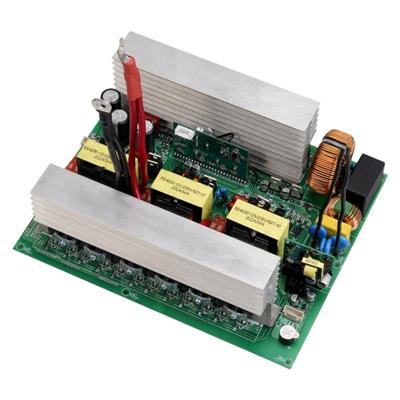
A PCBA board — a printed circuit board assembly — is the part of an inverter that does the electrical work: power stage, control board, heatsinks and transformers that turn battery DC into mains AC. It comes without the rest: no metal enclosure, no AC sockets, no DC cables and no user manual. A board is a semi-finished product, not a cheaper finished inverter.
Sunrise New Energy lists nine boards in its inverter PCBA board range: REP500-800, REP-1000, REP-1500, REP-2000, REP-3000, REP-5000 and REP-8000 in the pure sine wave family, plus the PU1500 and PU2000 bidirectional boards. The REP family covers 500W to 8000W. All are supplied for OEM assembly, and custom DC input voltages can be produced on request.
REP Boards vs PU Bidirectional Boards: What Is the Difference?The split in the range is simple, and it decides most purchases. REP boards only invert: battery power in, AC power out. They are the core of a standard pure sine wave inverter. PU boards work in both directions: they invert battery power to AC for your loads, and they charge the battery back from AC mains. That makes a PU board the core of a UPS-style inverter or backup system, which keeps loads running in a power cut and recharges the battery when mains power returns.
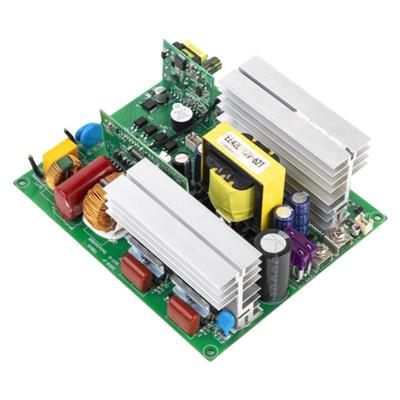
The two 2000W boards show it clearly. Both are rated 2000W continuous with 4000W peak, in 12V, 24V and 48V versions, sharing the same protection thresholds: low-voltage alarm 10.5±0.5 / 21±0.5 / 42±1V, shutdown 10±0.5 / 20±0.5 / 40±0.5V, recovery 12.3±0.5 / 24±0.5 / 48±1V, over-voltage protection 15.5±0.5 / 31±0.5 / 61±1V, and over-voltage recovery 14.8±0.5 / 29.5±0.5 / 59±1V. Both are pure sine wave, THD under 3% on a linear load, maximum efficiency 90% / 92% / 95% (12V / 24V / 48V), no-load current 0.9A / 0.5A / 0.3A. They differ in size, weight and charging: the REP-2000 bare board is 240 × 191 × 70 mm and 1890 g, while the PU2000 is 293 × 200 × 70 mm and 2340 g, adding charging current of 30A / 20A / 10A for the 12V / 24V / 48V versions — charging current varies by version, so check the parameter table.
One note: the PU2000 page describes the PU series as covering 1500W, 2000W and 3000W, but the category page currently lists only the PU1500 and PU2000. Treat those two as the boards on offer, and confirm any other PU size first.
How to Choose a Board in Three StepsStart from the loads, not from the board. A finished 2000W unit built on the REP-2000 board runs a fridge with lights and a TV, an 1800W kettle on its own, or power tools on site, with 4000W peak for motor start-up. Smaller lists — lights, a laptop and phone charging — need only a 500W to 1000W board; larger ones go up to 8000W. Pick the board after the load list, and leave headroom for start-up surge.
Every board comes in 12V, 24V and 48V versions, input range 10–15.5V / 20–31V / 40–61V. Higher voltage means lower current for the same power — thinner cables and smaller fuses — but battery bank, charger and board version must all agree. Wire size and fuse ratings must follow the manual for the finished unit.
If the finished inverter only needs to turn battery power into AC — for a vehicle, a workshop or a campsite — a REP board is enough. If it must also recharge the battery from mains power — a UPS or a home backup system on standby — you need a PU board. Adding charging later to a REP-based design is a different product, not a wiring change.
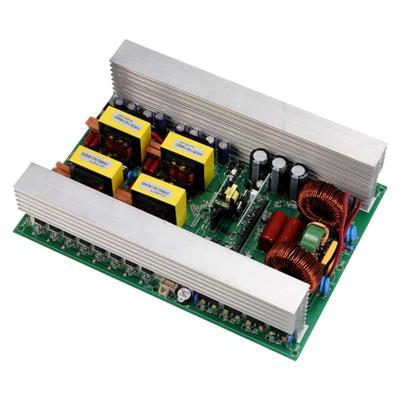
Buying the board is the middle of the job, not the end of it. The builder still provides the enclosure and airflow around the heatsinks, DC wiring and fusing, AC sockets for the destination market, labels and manual, and the certification the target market requires. None of that is on the board's parameter table, which also lists no USB outputs, packaging or warranty terms — so do not plan around figures the board page never gives.
Two rules keep an OEM build on track. First, read the parameter table of the exact model you order — thresholds, no-load current and dimensions differ between power bands, so the REP-2000 or PU2000 figures here must not be applied to other boards. Second, confirm the finished specification in writing — power, voltage version, charging current for a PU board, socket type and destination market — before production starts.
When a Finished Inverter Is the Better BuyFor many buyers, the honest answer is to skip the board entirely. If you need one inverter for your own vehicle, RV or home backup, a finished unit is ready to wire in, with enclosure, sockets, cooling and manual already done. Our own 1000W sizing guide covers what a finished 1000W pure sine wave inverter runs and how to size one from a load list — the same thinking, without the assembly work. Buy the board when you are building a product line or a brand; buy the finished inverter when you need power, not a project.
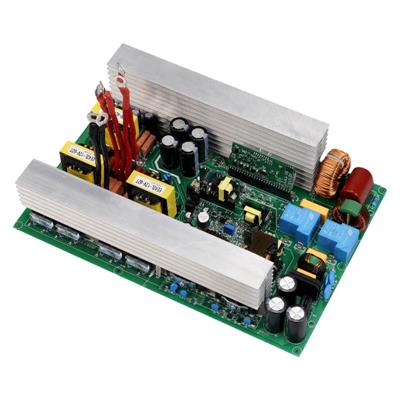
No. A PCBA board is the bare working core. It needs an enclosure, DC wiring and fusing, AC sockets, cooling airflow and a manual before it is a safe, usable inverter.
REP boards only invert battery power to AC. PU boards are bidirectional: they invert and they charge the battery back from AC mains, which is what a UPS-style inverter or backup system needs.
A PU board — the PU1500 or PU2000 listed on the site. A REP board cannot charge a battery, so a backup system built on one would need a separate charger. Confirm the charging current for your version on the parameter table.
Yes, for OEM orders. Tell the supplier the finished specification — power, voltage, charging needs and destination market — and confirm the board matches it before production.
Building your own inverter line, or choosing a finished unit instead? Contact Sunrise New Energy with your load list, battery voltage and target market, and we will confirm which board — or finished inverter — fits your build.

We use cookies to enhance your browsing experience, serve personalized ads or content, and analyze our traffic. By clicking "Accept All", you consent to our use of cookies.