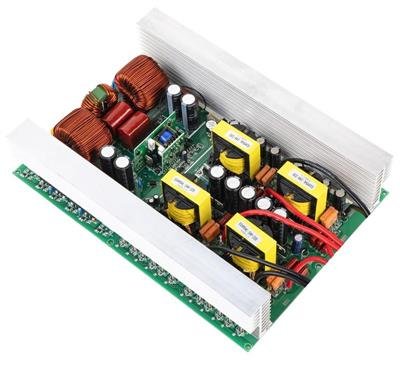
If your car has vehicle-to-load (V2L), it can power appliances directly from its traction battery; if it does not, a standalone car inverter connected to a 12V or 24V battery system is the practical way to get the same AC power in almost any car, truck or RV. This guide from Zhejiang Sunrise New Energy Co., Ltd. compares the two routes honestly, including where V2L stops and where an inverter still wins.
What Does Volvo's EX30 Update Show?Volvo is adding V2L to existing EX30 cars through a free over-the-air update, with new and existing cars covered and no workshop visit needed. Through a dedicated adapter fitted to the charging port, the car can supply up to about 3kW at 16A — enough, in the maker's own examples, for a coffee machine, power tools, campsite cooking, or keeping a refrigerator and other small appliances running during an outage.
That matters for the whole market. When a major car maker treats "the car as a mobile power source" as a headline feature, it confirms that using household power around a vehicle is now a mainstream need. V2L is also spreading from large EVs to compact models.
None of that removes the need for a standalone inverter today. It simply raises the question this article answers: what can drivers do when their own car does not have V2L?
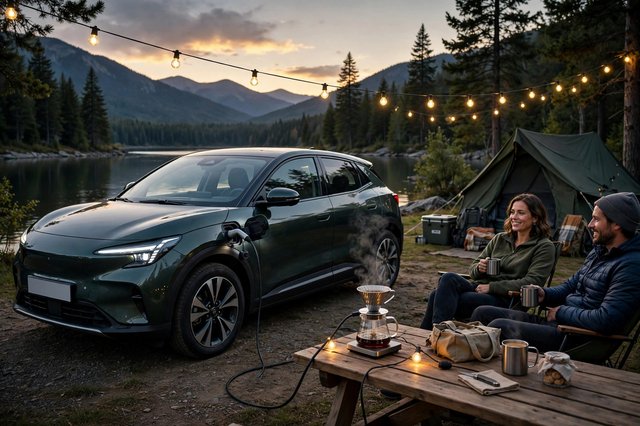
V2L is excellent where it exists — and unavailable everywhere else. That availability gap is its first and biggest limit.
V2L is built into the car; it cannot be retrofitted to a vehicle that left the factory without it. On the EX30, for example, the function is not offered in several major markets, including the United States, Canada, Mexico, South Korea, Taiwan and Japan, and the usable markets follow the CCS2 charging standard. A driver outside those regions, or with a different model, gets no benefit from the announcement at all.
The EX30 system tops out at about 3kW, and every watt comes out of the traction battery — the same battery you need to drive home. To protect drivers from stranding themselves, the car switches V2L off automatically when the battery falls below 20%. That is sensible engineering, but it means the usable energy is the band between your charge level and that 20% floor, not the whole pack.
The charging-port adapter is sold separately; it is not included with the car, and it only fits that charging standard and model family. A standalone inverter, by contrast, is not tied to one vehicle.
Who Still Needs a Standalone Car Inverter?Anyone whose vehicle has no V2L — which today means the large majority of cars on the road — still needs a standalone inverter to run AC appliances from a vehicle.
A fuel-powered car has no traction battery and no V2L, but its 12V battery and alternator system can run a correctly sized inverter for laptops, lights, small tools, travel fridges and emergency charging. For most of these drivers, an inverter is not an alternative to V2L; it is the only option.
Many electric cars, including recent ones, were sold without vehicle-to-load. Their owners face the same need at campsites, work sites and outages. A standalone inverter on a suitable 12V system, used within the car maker's limits, or on a separate auxiliary battery, gives them AC power without changing the car.
Trucks and RVs usually need power for many hours, often far from the cab's driving battery. A dedicated house battery plus an inverter sized for the job keeps fridges, microwaves, TVs and tools running without risking the starting battery — and, in an RV, without requiring the vehicle itself to be an EV at all.
There is also a flexibility advantage: one standalone inverter can move between a car, a workshop and home backup duty, and it can be paired with its own battery so it never touches your driving range.

Size an inverter from a written load list, not from a guess: add the running watts of everything you will use at the same time, then allow headroom for motor starting surges.
First, list the loads. A laptop might draw 60–100W, lights and phone chargers far less, a travel fridge roughly 50–100W while running, and kettles, coffee machines, microwaves and power tools commonly 1000W or more. Your total simultaneous load decides the continuous rating you need.
Second, respect surge power. Motors and compressors draw several times their running power for a moment at start-up. Choose an inverter whose surge rating covers your largest motor starting while your other loads are already running.
Third, choose pure sine wave output. Modern electronics, battery chargers, fridges and tools are designed for the same clean waveform the grid provides. For anything beyond a simple resistive load, pure sine wave is the safe default.
Fourth, match the battery to the job. A 12V system suits cars and smaller loads; 24V is common in trucks and larger RV systems. Bigger loads need properly sized cables, fusing and battery capacity, and heavy continuous loads belong on a direct battery connection — never on a cigarette-lighter socket.
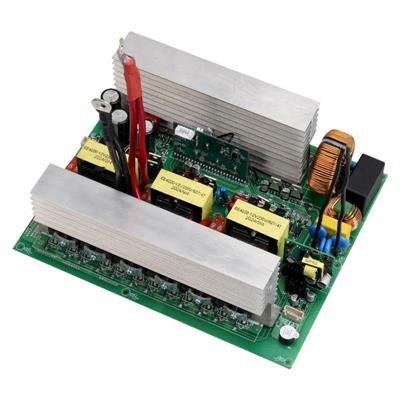
Can I add V2L to a car that does not have it? No. V2L is factory hardware and software; it cannot be retrofitted. The practical equivalent for a car without it is a standalone inverter on a 12V or 24V battery system.
Will a standalone inverter drain my car battery? It can if it is left running without the engine or a charging source, which is why sizing and battery choice matter. Use an auxiliary or house battery for long or heavy loads, observe low-voltage protection, and never risk the battery you need to start the car.
Is V2L better than a standalone inverter? For an owner whose car already has it, V2L is clean and convenient for occasional use up to its limit. A standalone inverter is better when your car lacks V2L, when you need power away from the car, or when you do not want to spend your driving range.
V2L or Inverter, Start With the Car You OwnThe right answer follows from one fact: whether the vehicle in your driveway today actually offers V2L, in your market, with its adapter. If it does, enjoy it. If it does not — a fuel car, an older EV, a truck or an RV — a correctly sized pure sine wave inverter delivers the same practical result: ordinary AC power, where you need it.
Zhejiang Sunrise New Energy Co., Ltd. supplies pure sine wave car inverters and vehicle power systems for cars, trucks and RVs. Tell us your vehicle, your battery voltage and the appliances you want to run, and we will recommend the right size. Visit cninverter.com or contact us: WhatsApp 86 17706649699, email Long@cninverter.com.

We use cookies to enhance your browsing experience, serve personalized ads or content, and analyze our traffic. By clicking "Accept All", you consent to our use of cookies.